Showing posts with label Transition Person. Show all posts

Wednesday, June 23, 2010

Three Gallon Drought Dish Washing

Drought dishwashing
Drought Dish Washing at the Debi Cates Home

I enjoy washing dishes. Good thing, too, since I don't have a dishwasher. The machine, non-me kind anyway.

My little house was built probably in the late 40s or early 50s. There are lots of challenges for modern living in an older home, especially one just 800 square feet. I have a heck of a time finding furniture that's sized moderately enough not to look like a gorilla stuffed in a shoebox. And don't get me started on the stingy number of electrical outlets. Thank heaven for power strips because otherwise I'd be writing this blog on a manual typewriter. Then there's the time I tried to install a clothes washing machine in the back add-on room with its badly done peer and beam floor, a funny story for the scrapbook...

Where was I? Oh yes, hand dish washing. You won't find it surprising then that my house does not have a dishwasher installed. Here are five steps I've been perfecting to conserve both water and the energy to heat it, yet to get dishes as clean as humanly (this human) possible.

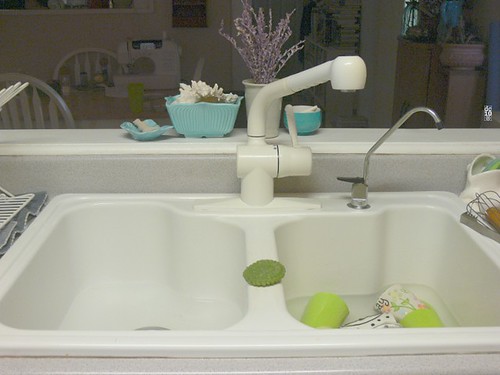
1. Fill each side of the sink with one gallon of hot water. You read right, just one drought-thrifty gallon per side. And I only do dishes once per day  depending on how much I cook but never more than once a day. The third gallon is to pre-rinse while waiting to wash (see hints below). Until this method becomes second nature to me -- it's not yet -- I've been using a pitcher to measure the water.

2. Do not put dish washing soap in the water. Instead I directly squirt my dish scrubber, the round green one in the photo. My daughter crochets these scrubbies out of tulle. They're my favorite, soft enough not to scratch cutlery and strong enough to scrub pots. Not putting a big squirt into the water, I'm using a lot less dish soap. A penny saved is a penny earned.

3. Wash the items that touch your mouth first.  I learned this rule from my mother, at the tender dish-washing age of six. That would be your glasses and silverware, the dishes you'd like the most clean, washed while the water is hottest and cleanest.

4. Scrub out of the water. By washing each dish in my hand, not in the sink, I can give it a dunk in the wash side which isn't made wildly soapy by directly washing there. Then ready for the crystal clear rinse in the left side. Doing this also reduces even further the amount of soap I use since my sudsed-up scrubber never goes in the water.

5. Continue washing from cleanest to dirtiest. Common sense, I know. The wash water will get inevitably dirty as you go along, but here are a few things that might help:
  • Scrape: I use a rubber spatula to scrape plates and bowls, which to my delight gets them as clean as pre-wash possible. For pots and pans, Pampered Chef sells three nylon pan scrapers for $3. They work wonders and will outlast you. I've used the same one for over 15 years and it looks new. Also good for scraping off mooshed-in gunk on floors.
  • Soak: Between washing, I keep a one gallon mixing bowl by the sink full of water. I pre-rinse dishes in it, or soak things I know will set hard as rock, like eggs and breakfast cereal. On days I'm not lazy, I will even pour that dirty water outside onto the compost bin which in my desert clime, always needs watering.
  • Grease or Oil: I have a septic tank so am especially aware the bad effect grease has on drains and sewage systems. I haven't yet devised a good method for responsibly disposing of cooking oil since it is one of the things I don't compost. I try to use as little as possible, throwing away used oil in the trash. In any case, not having excess oil or grease on the dishes is helpful.
  • Pink Cup: I have this one small pink plastic cup, an odd man out. Since I'm not using much water, and when the sink is full of dishes, it's sometimes hard to fully rinse. I use that cup to scoop and pour rinse water when there's not enough room to dunk. 
After years of washing dishes with a full, sudsy sink and after years of always rinsing under running hot water, it's a big step for me to perfect washing with less water, less expense, and hopefully less effort to boot.

What hand dish washing hints do you recommend? For those with dishwashers (the non-human kind), feel free to share your best green hints as well.

Thursday, June 03, 2010

Beauty and the Beast

Wicked beauty

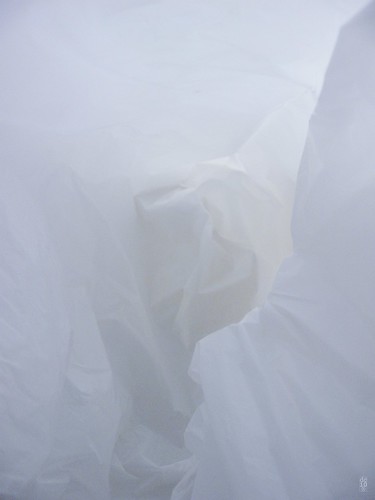
What is it? It's the interior of a freshly changed "tall kitchen" trash bag, so tidy. Beautiful, even.

Um, maybe more like a beast.

Fossil fuel energy is used to make plastic like that bag. In addition, plastic itself is made of petroleum. At every stage of production and use, plastic releases toxic by-products. News stories are revealing more and more frequently the frightening health effects from those chemicals, chemicals now found in our bodies.

Not only that, the plastic from this bag will still be around in the year 2510, or maybe 3010. No one knows exactly how long because, well, it takes so long to biodegrade.

Burning plastic to be rid of it, isn't a good option either. My son-in-law is a fireman and could tell you about the noxious plumes from a home filled with a standard amount of plastic when it burns.

Come on, this is just a bag and I'm only using one a week. That's 52 bags a year for me, one person. And 52 bags per person in the U.S. would be 16,089,372,000 bags a year. Sixteen billion bags just to throw away stuff. And since it doesn't biodegrade, what about the plastic from last year? Or 1990? Or 1950?

Every bit of plastic ever produced still exists today.

What can a person -- transitioning or not -- do to move away from petroleum-based plastic?

I could keep reducing my garbage, ultimately using fewer and fewer of these bags. There is no warning on the box, so one bag can't be all that bad. Wait, there is this one label on the box, in small print: "Not recommended for food storage." Why? Because it would leach bad stuff out into your food. Not good for food, not good for the ground, not good for you.

I could buy the oxobiodegradable plastic bag. Or I could buy biodegradable bags made of tapioca. In any case, I looked for them in my local grocery store, 2 miles from home, but they carry neither. It doesn't makes sense to me to drive across town for them, nor to indirectly burn gasoline by having them shipped to my doorstep from Amazon either.

Even if I could find some locally, a bit of googling revealed that the tapioca just entices micro-organisms to eat that part of the bag, then seeds the environment with polyethylene fragments. And the oxobiodegradable has additives that make them breakdown, releasing carbon dioxide and methane far more quickly, contributing to greenhouse gasses. Besides, I don't trust the corporate guys to tell all they know. Or even to know all they should know.

In desperation, I could at least re-use the ubiquitous plastic shopping bags that I bring purchases home in. Then I wouldn't be encouraging more plastic to be made. Since I'm currently sewing cloth shopping bags, my days of having a plethora of plastic bags are numbered, though.

I then looked in my garbage for the solution.

Monitoring my trash these last weeks, I noticed something. I throw away plastic bags. There's the plastic bag popcorn comes in, the big plastic bag toilet paper comes in, the plastic-coated bag dog food comes in. There's a bunch of them each week and not made of the kind of plastic taken by my recycle center. How ironic is it that plastic bags fill up my trash. Why throw them away in yet another bag?

Yep, I like this idea and I've begun saving my "trash" as trash bags. It will work both toward my goal of reducing my contribution to the landfill and reducing fuel consumption. Well, at least for as long as the stuff we buy is mostly, sometimes only, available packaged in plastic.

It's not a solution against the many health dangers of plastic. It's not as tidy as the bag above. It certainly won't be beautiful. But you know what I'm thinking? Those 16 billion white, tall bags bulging with garbage couldn't possibly be tidy or beautiful either.


Links
GLAD's
® declaration of dangerous chemicals not used in their production. What is their stuff made of? It's not answered. Probably for a reason.
CNN's article "5 toxics that are everywhere: Protect yourself."
CNN's video "One woman's mission to be plastic-free."
The animated Internet sensation, "The Story of Stuff."

Tuesday, June 01, 2010

Transition Culture


Remember when I told you I was becoming a transition person, based on Transition Towns? I'm including a video below that explains it beautifully, an interview with the idea's co-founder, Rob Hopkins. He's such a nice guy!

In brief, transition culture attempts to put into action the answer to "How might our response to peak oil and climate change look more like a party than a protest march?"

Whole towns right now, today, are transitioning away from reliance on fossil fuels, ahead of when that energy will no longer be cheap. (Oil industry experts predict the painful increase is beginning now, many years before oil actually runs out or costs more to drill than it produces.) These towns are trying out various solutions for themselves, not waiting until things will be frightening and panicky. That's the "transition."

And, you know what? Instead of feeling overwhelmed, saddened and manipulated by forces outside of myself, I'm feeling empowered and capable. By golly, it's even fun.


Thursday, April 22, 2010

Small New Leaf on Earth Day

Little leaves
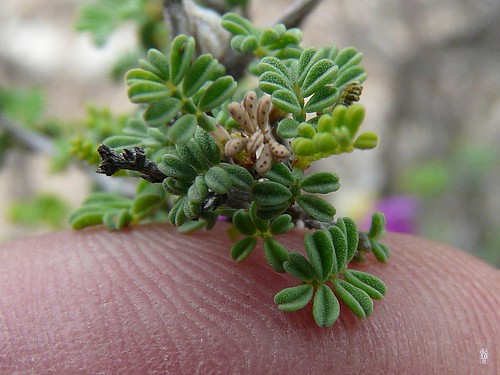
On the tip of my finger the tiny leaves of the feather dalea
(Click any image to view much larger on Flickr)
West Odessa, Texas


After my Spring month of renewing, I am renewed. Have you heard of Transition Towns yet? If not, you will. Me, I am embarking on becoming a Transition Person.

First let me tell you my story.

For twenty-five years I worked as a computer programmer with decent salary. I drove 24 miles to arrive at the office, where I spent eight hours sitting under florescent lights, solving unending technical problems, and frequently enduring immense stress. Then I would drive 24 more miles back home to hopefully find a free hour or two to enjoy the parts of life that make it worth living. By most standards, it was a good job. A good life.

Last October, I was laid off due to the economic downturn.

Not surprisingly, since then I've had time to do some thinking. I've been thinking about the decline of my health due to lack of exercise, fast food, and continual stress. I've been thinking about all the apparatuses that it took to keep that commuting job -- the clothes to buy, the vehicle to ever maintain, the need to pay others to do what I didn't have time to do or learn to do myself, and even the medical expenses related to poor health maintenance. Saddest of all, I've been thinking about how during most of those hard-working years, I was raising my children, children I didn't have time to give enough of the simplest and most important thing of all -- my patience, my attention.

I wasn't unaware of my predicament. I simultaneously dreamed of getting out of that work-spend cycle and was also terrified of doing so. Inside me, though, was a young 70s chick who never stopped dreaming of a simpler, more valuable life. The dream included time to garden, to crochet, bake bread, learn about plants, read a book a week, know the seasons intimately and not just from a glass window. More importantly, my heartfelt dreams included time to listen and to love. Somehow I did squeeze in a few of those things through the years, but time was time stolen from housework or from sleep.

Everything has changed. Not only am I off the treadmill -- it basically took my getting kicked off to get here -- but I don't want to get back on.

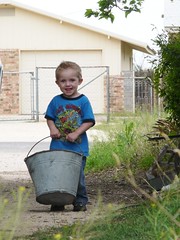
My helping handMy story now is that my children are grown, but my grandchildren are very young and live just a mile away. Another "small new leaf," the one pictured on the right, is my grandson, Little C Man, helping me with some garden chores. I want to be the grandmother to my grandchildren that my grandmothers were to me -- patient, loving, and bestowing ancestral resourcefulness.

Now I'm almost 51 years old but my "Real Age" is a shocking 9.2 years older than my calendar age. The good news is I have time to focus on taking care of myself with exercise, giving up my bad habits, and eating better. I have plenty of time in the day to do these things and I might end up having more time in my lifespan if I do.

Even the Internet is something now added to my personal equation of changes in my life, although not all that new. Still, it's a fabulous tool, and getting fabulouser all the time. With it we can now can research any subject, any problem, any plan, and seek out like-minded others with no more than a few keyboard clicks.

My past is indeed gone. Gone is youth, but also gone are old fears. I like being here now. I like being one of many Americans prepared to change. It's exciting and promising to begin my conversion to a Transition Person, transitioning away from reliance on fossil fuel. We have traveled so far on this road that it won't be easy. Luckily, we also live in a time of great ingenuity and connectedness. Besides, hasn't the most precious collections of wisdom -- those of religion -- emphasized exactly that? In virtually all religions you will find the premier lesson that ease is not equated with quality of life, with quality of spirit. Some struggle and a lot of honest work is good for us.

Rest assured, I don't plan to regale you with thoughts on being against anything. We're all more than a little sick of that. I'll be focusing on what I am for. I'm for having more time to be in the moment, more sense of global responsibility and fairness, more physical exertion, more abilities that are resilient against down-turns or corporate strategies, more empowerment. And at the heart of it, I'm for more optimistic action to improve quality of life for this and many next generations.

But I don't plan to talk much more about the idea of what I'm doing either. Yawn. Instead I'll be writing about how I implement changes. I'll be thinking this through more thoroughly in the days and weeks to come. Questions I'll be asking myself are: How exactly will I measure my reduction? What is a measurable goal? How do I simply not trade one pollutant for another? How do I improve my health sufficiently to become physically able to do the things that will need to be incorporated? How can I reduce my own piles of stuff without dumping in the landfills? How to stay focused on facts, not politics? And even how will I financially support myself in a way that is in balance with these goals?

A tall order. And just the kind of thing I've always wanted to do and be.