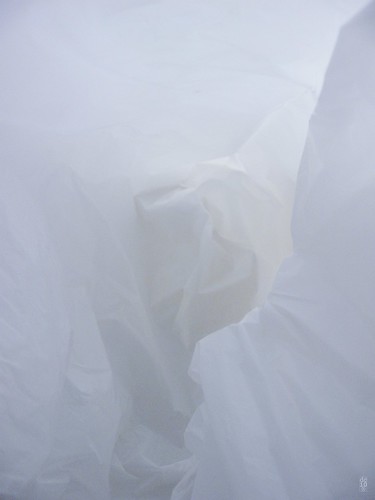
What is it? It's the interior of a freshly changed "tall kitchen" trash bag, so tidy. Beautiful, even.
Um, maybe more like a beast.
Fossil fuel energy is used to make plastic like that bag. In addition, plastic itself is made of petroleum. At every stage of production and use, plastic releases toxic by-products. News stories are revealing more and more frequently the frightening health effects from those chemicals, chemicals now found in our bodies.
Not only that, the plastic from this bag will still be around in the year 2510, or maybe 3010. No one knows exactly how long because, well, it takes so long to biodegrade.
Burning plastic to be rid of it, isn't a good option either. My son-in-law is a fireman and could tell you about the noxious plumes from a home filled with a standard amount of plastic when it burns.
Come on, this is just a bag and I'm only using one a week. That's 52 bags a year for me, one person. And 52 bags per person in the U.S. would be 16,089,372,000 bags a year. Sixteen billion bags just to throw away stuff. And since it doesn't biodegrade, what about the plastic from last year? Or 1990? Or 1950?
Every bit of plastic ever produced still exists today.What can a person -- transitioning or not -- do to move away from petroleum-based plastic?
I could keep reducing my garbage, ultimately using fewer and fewer of these bags. There is no warning on the box, so one bag can't be all that bad. Wait, there is this one label on the box, in small print: "Not recommended for food storage." Why? Because it would leach bad stuff out into your food. Not good for food, not good for the ground, not good for you.
I could buy the
oxobiodegradable plastic bag. Or I could buy biodegradable bags made of tapioca. In any case, I looked for them in my local grocery store, 2 miles from home, but they carry neither. It doesn't makes sense to me to drive across town for them, nor to indirectly burn gasoline by having them shipped to my doorstep from Amazon either.
Even if I could find some locally, a bit of googling revealed that the tapioca just entices micro-organisms to eat that part of the bag, then seeds the environment with polyethylene fragments. And the oxobiodegradable
has additives that make them breakdown, releasing carbon dioxide and methane far more quickly, contributing to greenhouse gasses. Besides, I don't trust the corporate guys to tell all they know. Or even to know all they should know.
In desperation, I could at least re-use the ubiquitous plastic shopping bags that I bring purchases home in. Then I wouldn't be encouraging more plastic to be made. Since I'm currently sewing cloth shopping bags, my days of having a plethora of plastic bags are numbered, though.
I then looked in my garbage for the solution.Monitoring my trash these last weeks, I noticed something. I throw away plastic bags. There's the plastic bag popcorn comes in, the big plastic bag toilet paper comes in, the plastic-coated bag dog food comes in. There's a bunch of them each week and not made of the kind of plastic taken by my recycle center. How ironic is it that plastic bags fill up my trash. Why throw them away in yet another bag?
Yep, I like this idea and I've begun saving my "trash" as trash bags. It will work both toward my goal of reducing my contribution to the landfill and reducing fuel consumption. Well, at least for as long as the stuff we buy is mostly, sometimes only, available packaged in plastic.
It's not a solution against the many health dangers of plastic. It's not as tidy as the bag above. It certainly won't be beautiful. But you know what I'm thinking? Those 16 billion white, tall bags bulging with garbage couldn't possibly be tidy or beautiful either.
Links
GLAD's ® declaration of dangerous chemicals not used in their production. What is their stuff made of? It's not answered. Probably for a reason.
CNN's article "5 toxics that are everywhere: Protect yourself."
CNN's video "One woman's mission to be plastic-free."
The animated Internet sensation, "The Story of Stuff."

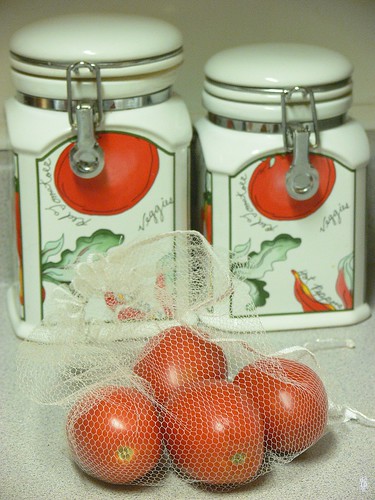
 For my sewing friends, here's a tip on working with net, which is like trying to sew air. For a stabilizer, I used regular paper which I was able to tear away easily when done. Used envelopes, flattened out, would work very well for this purpose.
 Today my daughter and I are headed to the Midland Downtown Farmer's Market for the first time! I wish it wasn't 30 miles from here. Still, that's a fraction of the distance most produce must travel to get to my local grocery store, I'm sure.

